Regenerative medicine – Use of platelet-rich plasma (PRP)
The use of platelet-rich plasma (PRP) in reproductive medicine has been introduced in recent years. The benefit comes from the various growth factors contained in the platelets, which have a regenerative effect. The therapeutic goal is different depending on the site of application.
Ovarian application
With advancing age, the ovarian reserve and the quality of the oocytes decrease. The injection of PRP into the ovaries aims to counteract this by interacting with the resident stem cells, thus leading to an improvement in the ovarian reserve markers.
Women with endometriosis and adenomyosis can also benefit from the use of PRP.
It is an inexpensive, easy-to-use technique, that carries almost no risks and shows promising results.
Which are the steps of ovarian treatment with PRP?
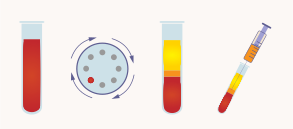
The first step is a blood draw. Then, in a procedure called centrifugation, the white blood cells, platelets and red blood cells are separated. The platelet-rich plasma is selected.
In the next step, the PRP is injected into the patient’s ovaries under sterile conditions and in the operating theatre under sonographic guidance.
Injection into the endometrium
In addition to the ovarian reserve, the integrity of the uterine lining (endometrium) is also crucial for the development of a pregnancy. The endometrium grows and changes under the influence of hormones produced cyclically by the ovaries. Many women have disorders in the development of the mucosa. Injection of PRP in various places of the mucosa stimulates the growth of the endometrium, creating better conditions for the reception of an embryo.
How is it injected into the mucous membrane?
Using a uterus endoscopy, the mucous membrane lining of the uterine cavity is visualized. After obtaining the PRP (as described above), it is injected in several places, so that it can lead to an even endometrial build-up in the next cycles.